

In March 2026, the Middle East conflict pushed Australian pump prices above $2.50 a litre. The ACCC received more than 500 price-gouging complaints and launched an inquiry. The political conversation fixated on retail margins.
Then attention turned to the more uncomfortable number: Australia holds fewer than 40 days of strategic petroleum reserve - around 36 days of petrol, less for diesel and jet fuel. The international standard is 90. The two domestic refineries that underpin that buffer are commercially viable only because the federal government subsidises them to stay open.
Australian pump prices are not set by competitive dynamics. They are set by geopolitics, translated through Singapore refinery benchmarks, and passed on to consumers who have essentially no alternative but to pay them. The ACCC inquiry will come and go. The structural exposure remains.
I wrote about it here:

and here:

Against this backdrop, three companies have made large bets on the Australian fuel retail forecourt. One has already lost. The other two are mid-execution, and the gap between them is instructive.
Signal in the noise
Three things matter more than the price cycle right now:
The forecourt food and café occasion is the only growth vector in this sector. Fuel volumes are declining - efficiency improvements and modest EV adoption are reducing litres-per-vehicle by around 1.5% annually. Non-fuel convenience revenue is growing at 2–3% per year. The operators investing disproportionately in food, coffee, and in-store experience are not managing decline. They are building businesses that will outlast the pump.
Upstream control determines whether your retail strategy is viable. An operator that cannot control its cost of goods - because it buys 100% of its fuel from its largest retail competitor, under a 15-year exclusive agreement - does not have a retail strategy. It has a slow bleed. Australia’s import dependency (~90% of fuel) and the vulnerability of its supply chain to Middle East disruption mean that integrated operators (refinery + terminal + retail) hold a structural floor that pure retailers cannot replicate.
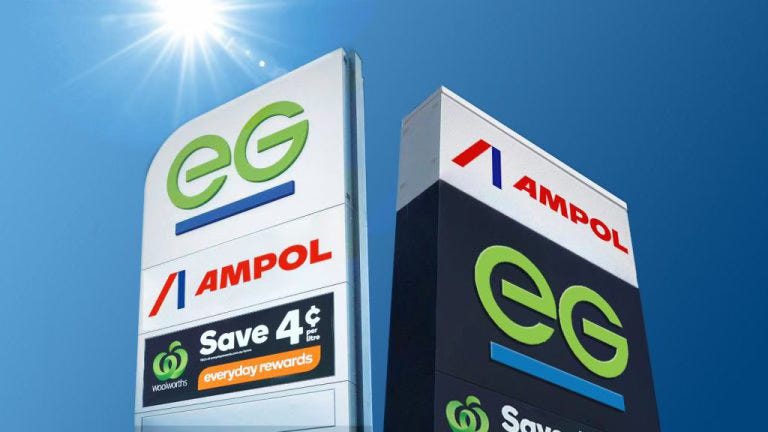
June 9, 2026 resets the competitive map. The ACCC rules on Ampol’s proposed A$1.1 billion acquisition of EG Australia on that day. If cleared at scale, Ampol becomes the dominant integrated operator with ~1,100+ retail sites, Australia’s largest grocery loyalty flywheel, and a format rollout across the combined network. The number of sites Ampol is forced to divest is the leading indicator: watch it.
The three conditions
Fuel is a grudge purchase. Nobody enjoys buying it, nobody feels good about the brand on the pump, and most decisions come down to proximity and whatever’s cheapest that day. This is a fact of the category, not a failure of marketing.
It has a specific implication for loyalty. Motorists do develop brand loyalty, but not in the aspirational sense. They become loyal to the station they habitually use, which is almost always the one that was most convenient when the habit formed. Commute route. School run. The turn they make without thinking.
This means loyalty programmes mostly reinforce behaviour that would have happened anyway. A 4-cent-per-litre Everyday Rewards discount does not cause a rational consumer to drive 3 kilometres out of their way for a 50-litre fill-up saving of $2. What it does is make a customer who was already going to stop there feel better about it - and associate Woolworths with that decision.
Genuine customer-switching - stealing a competitor’s habitual customer - requires something qualitatively stronger than a discount. It requires the customer to actively choose to divert. The only reliable mechanism for that in a grudge purchase category is a materially better experience - for the buying context.
These dynamics produce three conditions for sustainable competitive advantage in Australian fuel retail:
Upstream control
Owning or controlling the supply chain - a domestic refinery, a terminal network, import infrastructure - determines your cost floor and your supply security. In a market where wholesale pricing is effectively set by your competitors, upstream integration is the difference between margin and margin compression.
Format quality
The forecourt’s non-fuel offer is the margin growth engine. Getting customers to choose your site over a competitor’s requires something worth choosing. The best Australian evidence is OTR in South Australia: non-fuel revenue exceeds 70% of EBITDA. The worst is EG Group nationally: approximately 23% of gross profit from non-fuel. That gap is not a marketing problem. It is a format investment decision.
Grocery loyalty integration
In a proximity-driven category, the strongest available mechanism for CEP activation - for inserting your brand into a buying decision the customer is already making - is linking to a grocery loyalty programme. Woolworths Everyday Rewards (~13 million members) and Coles Flybuys generate weekly touchpoints that the fuel occasion alone cannot produce. The keyword is exclusive: a shared loyalty programme is infrastructure, not a competitive advantage.
Three conditions. Every significant operator in the sector possesses some combination of them. One possessed none.
The failure case
EG Group Australia entered the market in 2019 by acquiring Woolworths Fuelco, 540 sites, for A$1.725 billion. The thesis was straightforward: apply the global convenience-first model to an underdeveloped Australian forecourt. Food. Coffee. In-store experience that makes fuel incidental. The company had done it in the US and the UK. Australia was the next market.
Six years later, EG agreed to sell its Australian operations back to Ampol for A$1.1 billion. The implied write-down: A$625 million, or 36% of the original purchase price.
The failure was structural, not operational. Every element of the deal EG signed in 2019 worked against the strategy it claimed to be executing.
The supply agreement trap was the most consequential. EG committed to a 15-year exclusive fuel supply agreement with Ampol, the company it was competing with at retail. Ampol set EG’s wholesale cost. With no supply leverage and no format advantage to justify a premium, EG could not consistently price below Ampol nor differentiate above it. The ACCC’s Phase 2 concern was precisely this: that the supply arrangement constrained EG’s ability to compete effectively, making it a compromised competitor rather than a genuine rival.
The format was never built. EG’s non-fuel gross profit reached A$84 million in FY2024, approximately 23% of total gross profit. Globally, EG operates Subway, Starbucks, and KFC franchises at its sites. None of those partnerships materialised in Australia. The in-store offer at Australian EG Ampol sites was not materially better than what was there under Woolworths Petrol. The convenience-first thesis requires a convenience destination. EG delivered a convenience gesture.
The loyalty gap was total. Everyday Rewards transferred to Ampol’s exclusive control. Flybuys operated at Viva Energy’s Shell/Coles Express sites. EG competed on price and proximity - the only two instruments available to a retailer with no format, no loyalty, and no supply differentiation.
Capital was not available. EG Group’s global leverage peaked at approximately 9.5x EBITDA. The Australian business was allocated what the balance sheet permitted, which was less than the format transformation required. The Australian thesis demanded disproportionate investment at the moment the parent company could least afford it.
The brand trap completed the picture. EG operated under the Ampol brand. Every customer interaction built Ampol’s mental availability, not EG’s. A convenience transformation requires a brand the customer associates with the in-store experience. EG had no such asset.
The ACCC’s Phase 2 filing is the verdict in a single sentence: the supply arrangement left EG neither cheap enough to win on price nor good enough to win on experience. In a margin-thin commodity category, that is not a competitive position. It is a managed exit.
The forecourt isn’t dying
The standard narrative on Australian fuel retail is managed decline: EV adoption erodes volume, ICE efficiency compounds it, and the sector gradually hollows out.
That narrative is partly accurate and mostly irrelevant.
EV penetration reached approximately 7–9% of new car sales in 2024. At that rate, the total vehicle fleet transitions slowly enough that petrol volume remains the dominant fuel demand for well over a decade. The more immediate threat to forecourt economics is not the EV charger but the failure to build a non-fuel revenue stream that survives the volume decline when it does arrive.
The operators building now - Ampol’s Foodary format, Viva’s OTR rollout - are making a bet that the forecourt becomes a food and café destination, with fuel as the traffic-generating infrastructure rather than the product being sold. In South Australia, that bet has already paid off. OTR sites generate more than 70% of their EBITDA from non-fuel revenue; EG’s equivalent figure was 23% of gross profit. Different denominators, same direction. People route past competitors to stop at OTR. The fuel is incidental.
The sovereign risk picture reinforces why the sector remains strategically relevant regardless of EV pace. Australia’s fuel supply chain runs through the Strait of Hormuz, Singapore, and Indonesian straits. The sub-40-day reserve is a thin buffer against a disruption that could last longer. Two domestic refineries - Lytton in Queensland, Geelong in Victoria - are the only domestic production capacity remaining. Both require government support to stay open. Both face policy cliffs in June 2027 when the Fuel Security Services Payment expires.
The ACCC may focus on price cycles. The structurally important question is whether those two refineries are still operating in 2030.
What to watch
Metrics
ACCC Phase 2 decision - divestiture count: Sets Ampol’s post-acquisition network scale; fewer divestitures = stronger integrated position.
Viva Energy OTR non-fuel EBITDA % at eastern seaboard sites: Whether the format travels outside SA/NT; the sector’s most important unanswered strategic question.
Ex-EG site non-fuel GP % under Ampol (baseline: ~23%): The integration benchmark; how fast can Ampol lift format quality on acquired sites.
FSSP renewal - government announcement: Whether domestic refining survives beyond June 2027; the supply security cliff.
ACCC terminal access obligations for independent distributors: The supply allocation to regional/independent retailers; more consequential than the price gouging inquiry.
Strategic petroleum reserve days of cover: Whether the reserve is being rebuilt post-crisis; the sovereign risk trajectory.
Key dates
June 9, 2026 - ACCC Phase 2 decision on Ampol/EG acquisition
Feb 2026 (published) - Viva Energy FY2025 results: 35 new OTR stores opened; Convenience & Mobility EBITDA up 7%; eastern seaboard non-fuel split not disclosed - the key data gap remains open
Feb 2027 - Ampol FY2026 results; first full year of EG network integration
June 30, 2027 - FSSP expiry for Lytton and Geelong; the refinery survival decision
The question that lingers
The consumer never aspired to a fuel brand. They became loyal to the one they habitually use - which is almost always the one that was most convenient when the habit formed. Stealing that customer requires giving them a better reason to divert. In South Australia, OTR has done it. The question for the next three years is whether that experience, and the 70% non-fuel EBITDA that comes with it, belongs to whoever can build it at national scale.
Next in this series: Ampol is running a refinery, a convenience business, and an EV network simultaneously. Only one of them explains why customers choose Ampol.