

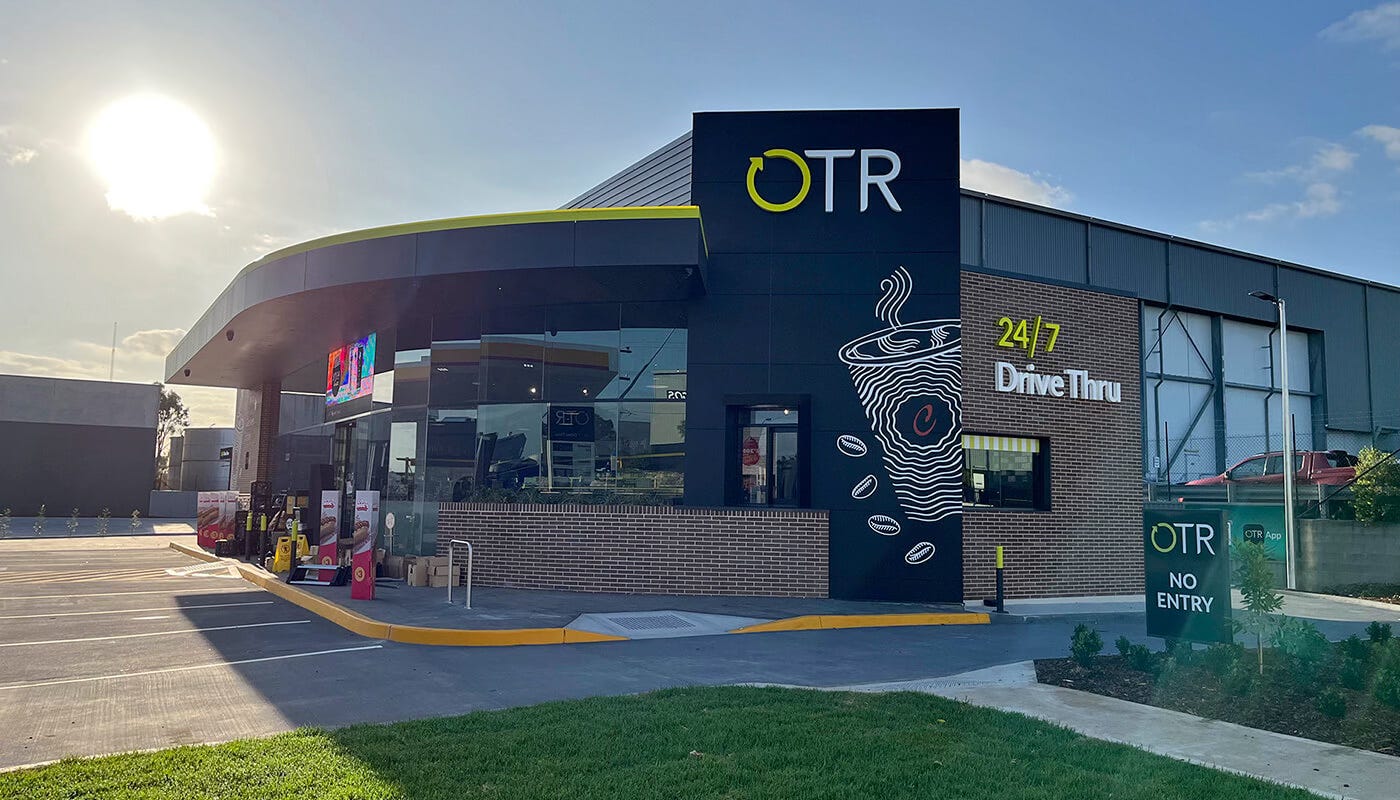
Pull off the Princes Highway heading into Adelaide and stop at an OTR.
Order a coffee. It will be good - not petrol-station good, actually good. The food will be fresh, the store will be clean, and there will be a queue of people who drove past two other petrol stations to get there. Non-fuel revenue at an OTR site exceeds 70% of EBITDA. The national average for a standard Australian service station runs closer to 25–30%.
In 2024, Viva Energy completed the acquisition of the company behind that concept for A$1.22 billion. The thesis: take Australia’s best forecourt convenience format and deploy it across Australia’s largest fuel retail network. Over one thousand Shell and Coles Express sites, converted progressively to OTR standard, with food and coffee replacing fuel as the primary profit engine.
If the format travels, Viva has the most defensible competitive position in Australian fuel retail. If OTR’s economics turn out to be a South Australian cultural artefact - three decades of accumulated brand identity, community familiarity, a business that functions like a local institution in ways it simply cannot replicate in Parramatta or Doncaster on day one - then Viva has made the most expensive regional branding decision in the sector’s history.
The eastern seaboard rollout is underway. The data is not yet in.
Two Theories of Winning
The sector article in this series identified three conditions for sustainable competitive advantage in Australian fuel retail: upstream supply control, format quality, and grocery loyalty integration. Ampol and Viva hold different versions of all three, but they have made fundamentally different bets about which one is the primary engine.
Ampol’s theory is availability. Be everywhere. Be the brand activated when a Woolworths member scans their card. Make the fuelling choice happen before the customer gets in the car. Format quality improves the margin per visit, but the primary lever is presence - physical and mental.
Viva’s theory is experience. Make the in-store product good enough that customers actively choose to divert. That is a different mechanism entirely - it creates deliberate routing behaviour rather than reinforcing a default decision. In South Australia, OTR has already proven it works. People route past closer sites to get there. The fuel is incidental.
Flybuys - operating across the Coles Express network - provides the loyalty infrastructure that holds the existing customer base while OTR conversions roll out eastward. But Flybuys isn’t the strategic bet. The bet is that a good enough experience generates the kind of choice that loyalty programmes can support but never create on their own.
What the Format Actually Is
OTR’s 70%-plus non-fuel EBITDA is the number everyone cites. What produces it is worth being specific about.
OTR built its SA/NT network around a food-first model: real kitchens, quality coffee, fresh food prepared on-site, staffed to restaurant rather than convenience-store standards. The result is a site where dwell time is longer, basket size is materially higher, and, critically, where the customer makes an active decision to go there rather than simply stopping because it’s there.
On the eastern seaboard, the competitive context is different. 7-Eleven is the embedded default convenience stop in Melbourne and Sydney. McDonald’s drive-through dominates the suburban coffee occasion. Ampol Foodary is growing. The question isn’t whether eastern seaboard customers want a quality coffee and a decent breakfast roll - they do. The question is whether an OTR site, without three decades of accumulated brand identity in the market, can generate the same routing decision from day one.
The evidence that experience-led formats can compete against global convenience and food brands is real. Wawa expanded its food-first model from Philadelphia across the US eastern seaboard into markets where 7-Eleven and McDonald’s were already entrenched - the format travelled on quality, not familiarity. Afriquia, Morocco’s largest fuel retailer, built a network around a destination food and service experience, competing directly against Shell and McDonald’s. Both companies made the same bet Viva is making: that a genuinely better in-store experience breaks the default decision.
The question is timeline. Both Wawa and Afriquia built their formats over decades in their home markets before the model was truly tested. Viva is attempting the same thing on a compressed schedule, in markets where Ampol Foodary and 7-Eleven are already competing for the exact occasion OTR needs to own.
The Execution Question
The format transferability question gets most of the attention. The execution question underneath it is harder.
Viva is integrating three large acquisitions simultaneously: Coles Express, Liberty, and OTR. Ampol, for comparison, is integrating one - and that one comes with an ACCC negotiation attached. Multi-acquisition integration complexity is not linear.
OTR’s format quality didn’t come from a brand manual. It came from specific people with specific standards, built over decades inside a company they owned and operated. Those people are now inside a listed petroleum company with quarterly reporting cycles and a Melbourne head office. The most important asset Viva acquired wasn’t the sites or the brand - it was the operational capability: the people who know how to run a commercial kitchen at service station standards, consistently, across hundreds of locations. If that capability doesn’t transfer, the national rollout produces OTR-branded sites with Shell Select economics.
There is also a capital question that rarely gets discussed. Geelong - Viva’s domestic refinery - provides the earnings base that funds the OTR conversion programme. Each site conversion carries A$0.5–1.5 million in capital investment. At full network scale over 5–10 years, that is a material multi-year capital commitment. The immediate policy concern has eased - the federal government extended the Fuel Security Services Payment to June 2030 in March 2026, removing the near-term cliff for both Geelong and Lytton. But the underlying dependency remains: Geelong’s earnings are still hostage to a global refinery margin Viva doesn’t control. If that margin turns hard in a bad year, the rollout pace slows - not because the format isn’t working, but because the funding engine is constrained.
If You’re on This Board
Three things require more attention than the rollout timetable.
Whether the format’s economics translate outside SA/NT. Viva’s FY2026 results will be the first meaningful read on eastern seaboard OTR performance. If management breaks out non-fuel revenue by geography and shows ratios above 50% in Victoria or New South Wales, the national thesis is tracking. If disclosure stays aggregate - all formats, all states, combined - that is a signal in itself. Companies disaggregate when the numbers are going their way.
Whether the OTR operational leadership is still in place. The format didn’t come from a brand playbook. It came from specific people with specific standards. If key operational leaders from OTR’s SA/NT business leave within the next 18 months, that is the earliest signal the capability isn’t transferring - and that the most important thing Viva acquired is walking out the door.
Whether Geelong’s earnings can sustain the rollout pace. The FSSP extension to 2030 removes the immediate policy risk, but Geelong’s profitability still moves with a global refinery margin Viva doesn’t control. Each OTR site conversion costs A$0.5–1.5 million in capital - at full network scale, that is a sustained multi-year commitment. A bad margin year doesn’t kill the strategy; it slows it, at exactly the point when eastern seaboard momentum matters most. Watch Geelong’s EBIT contribution alongside how many new OTR conversions management is actually committing to. A shrinking rollout in a year when Geelong earnings fall is the signal.