
The new duopoly flywheel
The grocery ‘price war’ is a distraction from the real engine of supermarket dominance: a compounding flywheel of private label, shopper data, and a $1 billion retail media machine.

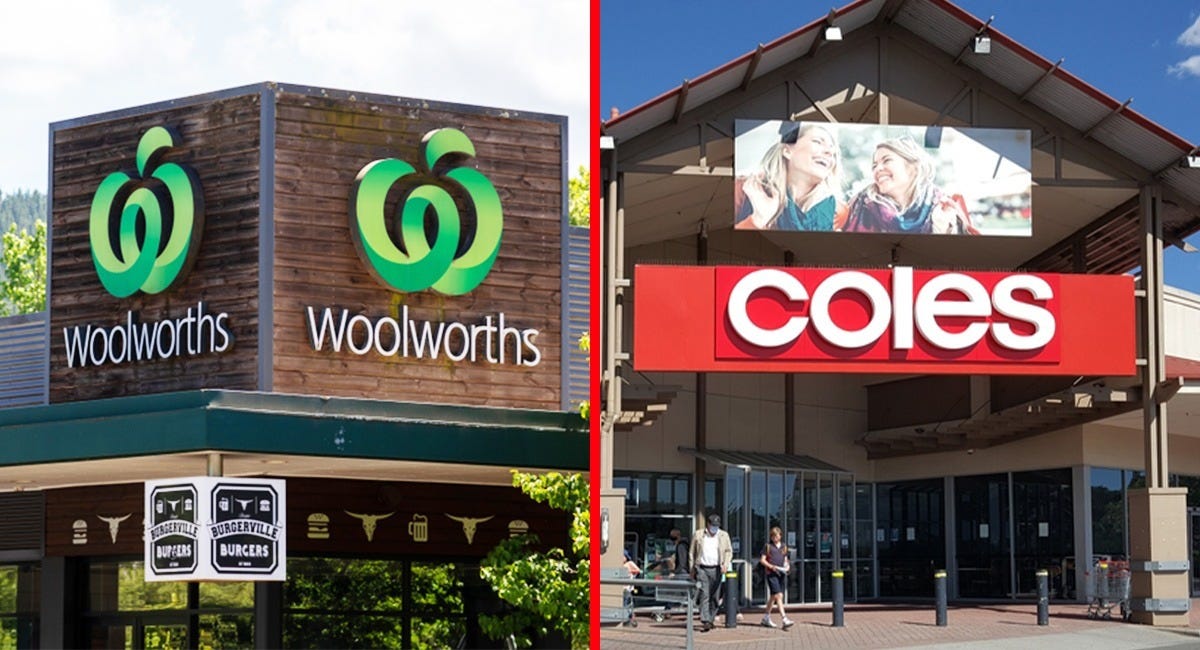
The ACCC spent two years asking whether Woolworths and Coles were too profitable. The inquiry produced 20 recommendations, a mandatory code of conduct from April 2025, and endless political theatre about shelf prices. But the regulator spent most of its time regulating the legacy grocery business without fundamentally understanding the new business model. Last year, the supermarkets’ in-house advertising arms—Cartology (Woolworths) and Coles 360—posted 19.5% and 13.5% revenue growth respectively. The duopoly now earns roughly $1 billion from selling digital ad inventory to its own suppliers, growing at four to five times the speed of their actual food sales.
The grocery “price war” narrative is a distraction. Woolworths and Coles are no longer just supermarkets; they are data and media businesses. Their core compounding advantage—a flywheel of scale, private label, loyalty data, retail media, and automation—is accelerating under cost-of-living pressure.
Signal in the noise
The real business is media. The duopoly generates roughly $1bn from ad inventory, a high-margin revenue stream growing up to 5x faster than food sales.
Cost-of-living accelerates the advantage. Inflation drives shoppers to private label and loyalty programs, fuelling the data-and-media flywheel.
Suppliers fund the flywheel. Suppliers pay for mandatory retail media to maintain visibility while losing shelf space to private labels.
Building the flywheel
The duopoly’s advantage is not a collection of separate strengths. It is a single, compounding system where each turn of the wheel makes the next turn faster.
Scale creates buying power, which fuels private label expansion. Those private labels now command around 30-35% of all sales. High private label penetration forces shoppers to use loyalty programs—now boasting 81% of Australian households—just to find discounts on branded goods. That loyalty data provides the exact audience targeting that powers the retail media networks. Retail media, in turn, generates the high-margin cash flow required to fund massive supply chain automation. Woolworths is dropping $700 million into its Moorebank logistics park, while Coles is spending $880 million at Truganina.
Automation lowers the cost to serve, which funds further scale. That is the flywheel.
It is easy to miss this system when you argue over cents on a carton of milk at the checkout. It is impossible to miss when you stand inside an $880 million automated distribution centre that moves 4.6 million cartons a week without human hands. You cannot compete with a robotics facility funded by an advertising business if your only lever is selling apples.
The cost-of-living accelerant
The very economic conditions causing political pain for the supermarkets actually accelerate their structural advantage. Food inflation and household stress push shoppers toward private label products, which 99% of households now purchase. Simultaneously, shopper stress increases reliance on loyalty program discounts and points.
These are the exact two behaviours the flywheel captures and monetises. You buy the cheaper home-brand pasta, you scan your Everyday Rewards card to get a few cents off your branded coffee, and the supermarket captures the data to sell a targeted ad back to the coffee manufacturer. The paradox of Australian grocery right now is that peak political pressure and peak structural profitability happen at the exact same moment, driven by the exact same consumer behaviour.
The margin extraction dilemma
The duopoly’s flywheel requires a constant supply of cash and data to keep spinning. The supermarkets extract that supply directly from the margins of branded FMCG suppliers.
Suppliers face a squeeze from both ends. They must pay for Cartology and Coles 360 advertising just to maintain physical and mental availability. Simultaneously, they lose physical shelf space to the supermarkets’ own private label equivalents. During the recent ACCC inquiry, suppliers anonymously reported feeling coerced into buying retail media packages under the implicit threat of losing their shelf placement.
The strategic question isn’t whether Woolworths or Coles wins the grocery war. The question asks at what point this extraction breaks the branded supplier ecosystem entirely. If the margin squeeze continues, food manufacturers will face a brutal choice: consolidate, exit the market, or stop innovating altogether.
What to Watch
The duopoly spins out their data engines.
The mandatory Food and Grocery Code protects suppliers from traditional buyer power, but it was not designed to regulate data monopolies. Watch for Woolworths or Coles moving to spin out, joint-venture, or structurally separate Cartology and Coles 360 from the core supermarket business. If political pressure mounts on how they force suppliers to buy ads, divesting the media arm keeps the cash flowing while technically removing the conflict of interest.
Private label crosses the 40% threshold.
At 30-35% penetration, private label acts as a highly profitable category management tool. As it pushes toward 40-45%, it fundamentally alters the economics of branded FMCG manufacturing in Australia. Watch the quarterly volume figures from Coles and Woolworths. If own-brand growth continues to outpace branded sales by >5%, brand owners will eventually consolidate or exit.
Retail media growth outpaces core retail growth.
The true measure of the flywheel’s speed is the divergence between grocery sales and ad sales. Watch the FY26 reporting for Cartology and Coles 360. If retail media continues to grow at 13-19% while core supermarket sales grow at 3-4%, the transition from grocer to media platform becomes permanent.
In the next article, I will look at how competitors are trying to beat the flywheel with true, distinctive strategic plays of their own.
Grada publishes strategic analysis for executives navigating complex markets