

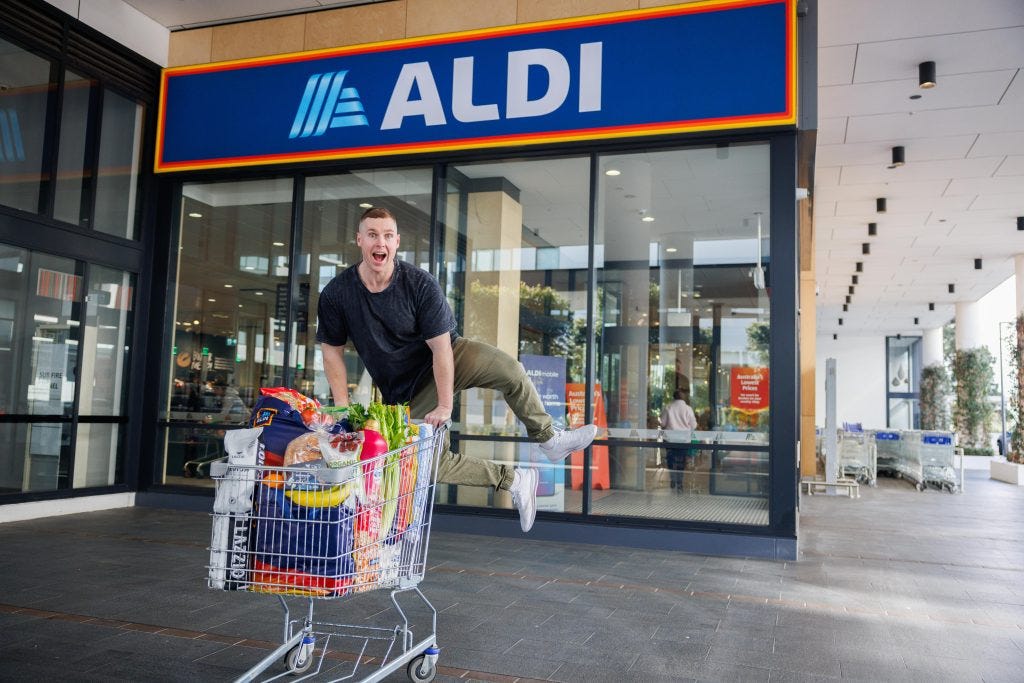
Between 2001 and 2020, Aldi executed one of the most successful retail disruptions in Australian history, taking its market share from zero to roughly 10%. But there the story stops. Today, six years later, despite expanding to nearly 600 stores, Aldi’s share remains pegged at around 10%. The plateau is not a failure of execution. It is the reality of trying to fight a compounding machine with a single weapon.
No current challenger is equipped to break the Woolworths and Coles flywheel by fighting them head-on. You cannot out-scale a duopoly that funds $880m automated distribution centres with high-margin retail media revenue. To beat the flywheel, challengers must abandon the volume war and exploit the structural blind spots of the incumbent model: hyper-local agility, uncompromised fresh food, and disciplined simplicity.
What makes the challengers compelling is that they have made genuine strategic choices by deciding what not to do. Instead of copying the duopoly, they are placing distinct, structural bets on exactly where not to play.
Signal in the noise
Aldi chooses the ceiling. Aldi caps its range at 1,800 SKUs and avoids loyalty programs, intentionally bypassing the flywheel to defend its 20-25% price advantage.
Independents abandon the volume war. Aggregating buying power to fight on price no longer works; the winning independent play is a deliberate retreat to premium, hyper-local differentiation.
The trap of scale. Growth destroys the challenger advantage. The moment a competitor adds complexity to chase the duopoly’s market share, they step into a capital war they cannot win.
Aldi’s calculated limits
Aldi’s plateau is a deliberate strategic choice to defend its cost advantage, rather than a failure to compete. They bypass the flywheel entirely by refusing to play the complex loyalty and range game.
Aldi caps its range at around 1,800 SKUs, compared to the 30,000 items you find in a typical Woolworths or Coles. It completely avoids the massive infrastructure cost of online delivery. This disciplined simplicity is exactly what enables their 20-25% price gap over the incumbents. Aldi accepts being a “partial basket” destination. If they tried to capture the full main weekly shop, they would require the exact complexity that feeds the duopoly’s flywheel.
Because Aldi is backed by the patient private capital of its German parent, ALDI SÜD, it does not need to chase high-margin media revenue to please public shareholders. It can afford to protect its price gap, keep its model ruthlessly simple, and slowly buy market share one physical store at a time. Rather than adding complexity, their only lever for growth is footprint expansion. Having reached their 600th store—and running out of traditional suburban greenfield sites—they are flexing their formats instead of their strategy, rolling out smaller “Corner Stores” in high-density urban areas and slightly larger footprints to fit foot-traffic-driving “Special Buys.”
The contrast is stark. Woolworths tracks millions of individual shopper profiles through Everyday Rewards, using that data to sell ads and squeeze suppliers. Aldi explicitly rejects loyalty programs to keep checkout speeds high and overheads low. They don’t beat the data machine; they ignore it.
Escaping the wholesale squeeze
The traditional independent strategy relies on using a wholesaler like Metcash to aggregate buying power to match the duopoly. That strategy is no longer enough when scale means funding robotics and media networks. The winning play is local differentiation, not national volume.
IGA’s share of the market has structurally declined as the duopoly’s supply chains became too efficient to beat on price alone. Metcash’s FY25 Food wholesale sales grew 3.8%, but its independent retailers lack the capital to match the duopoly’s massive digital scale. However, the independents that thrive—like Harris Farm or Drakes in South Australia—do so by focusing on premium fresh produce, local provenance, and deep community integration.
These are areas where centralised, algorithm-driven duopoly supply chains struggle. You cannot beat Coles on the price of Coca-Cola. You beat them on the quality of locally sourced, imperfect fresh produce, managed by an owner-operator with hyper-local agility.
The trap of trying to scale
The very things that allow challengers to beat the flywheel—extreme simplicity or hyper-local agility—are the exact things that prevent them from displacing the duopoly nationally.
Aldi wins on price because of its strict range limit, but that limit means it can never capture the full weekly shop. Independents win on premium, local fresh food, but that model requires owner-operator agility that breaks down across a national network.
The strategic dilemma for every challenger is the temptation of scale. To threaten the duopoly’s market share, you have to add complexity: more SKUs, more stores, online delivery infrastructure. But the moment you add complexity, you step into the path of a flywheel funded by a billion-dollar media business that you don’t have. Growth destroys the very advantage that made the challenger viable.
What to Watch
Amazon commits to the cold chain.
Amazon at 1% market share selling pantry staples is a minor annoyance to the duopoly. Amazon with a fresh food capability, is a genuine structural threat. Watch the recently announced partnership with Harris Farm Markets for same-day fresh delivery. If Amazon commits serious capex to a proprietary cold chain, they are placing a deliberate bet that some of us will prefer same day fresh delivery over the duopoly's physical store.
Independents retreat from the price war.
The traditional wholesale model tries to aggregate national scale to fight the duopoly, but some independents are finding alternative paths. Watch the supply chain moves of major regional players like Drakes, who built their own distribution centre to reduce reliance on Metcash. When top-tier independents break away to build regional supply networks, they are permanently choosing hyper-local agility over the price war.
Aldi compromises its simplicity.
Aldi fiercely protects its low-cost model, but as growth slows, the temptation to chase the duopoly’s basket size increases. Watch for Aldi introducing online delivery, click-and-collect, or significantly expanding its SKU count to capture the full main-shop basket. If they introduce complexity to chase growth, they risk eroding the very price gap that makes them competitive in the first place.
Grada publishes strategic analysis for executives navigating complex markets.