

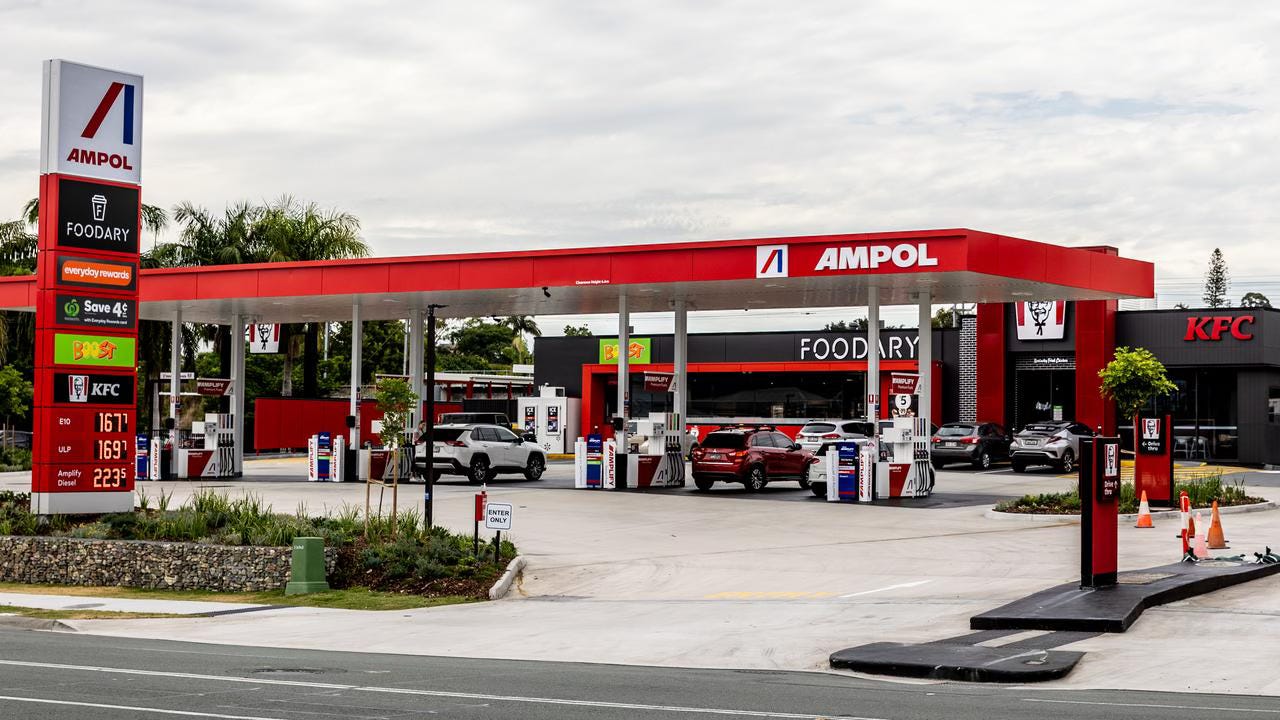
In FY2024, Ampol’s Lytton refinery lost A$42.3 million. A major equipment failure took it offline for extended maintenance. The government’s refinery support payments weren’t triggered. Lytton absorbed the loss on its own.
In FY2025, the global refinery margin recovered. Lytton swung to a A$163 million profit. Group result: A$947 million, up 32%.
Same asset. A$205 million swing between years. The difference was the global margin, not anything Ampol did.
Meanwhile, the convenience retail business delivered A$374 million in operating profit. It didn’t care what happened to crude margins in the Gulf. It just kept growing.
That contrast is the key to understanding Ampol. Lytton and the retail network aren’t parallel bets - they operate at different levels of the same business. The refinery provides supply security and wholesale self-sufficiency: Ampol isn’t entirely dependent on Singapore spot markets when disruption hits. The Woolworths Everyday Rewards ecosystem activates customers before they’ve decided where to stop. And the Foodary convenience format extracts the margin from each visit once they’re there. Lytton is the floor. The retail business is the strategy.
In early June 2026, the ACCC decides whether Ampol can acquire EG Australia’s 517 sites for A$1.1 billion. Understanding what’s actually at stake requires understanding that chain.
The Availability Play
As the first article in this series established, genuine loyalty in fuel retail is mostly behavioural - customers are loyal to the station they habitually use, which is almost always the one that was convenient when the habit formed. Changing that requires giving someone a reason to make a different decision.
Ampol’s theory is that winning a habitual purchase means winning the moment the habit forms, and that happens before the customer reaches the pump. Woolworths Everyday Rewards has approximately 13 million members shopping at Woolworths roughly 1.7 times a week. Every receipt can surface an Ampol fuel offer at the exact moment a driver starts thinking about where to fill up. Ampol inserts itself into a grocery behaviour the customer already has.
Physical availability reinforces the same logic from the other direction: be on enough routes, in enough suburbs, that choosing Ampol requires no detour. Network density and mental activation are the same strategy operating at different points in the same decision.
If cleared, the EG acquisition extends both. More sites means more routes covered, more suburbs where Ampol is the proximate choice, and more places where an Everyday Rewards member can redeem a voucher, compounding the loyalty effect. The ACCC’s Phase 2 review has flagged 115 local markets with competition concerns - precedent suggests clearance with divestiture conditions rather than outright blockage. The divestiture count determines how much of the strategic rationale survives: under 30 forced sales, the density thesis is largely intact; at 80-plus, the sites surrendered are likely to be in exactly the high-overlap urban corridors where density does the most work.
There is, however, a question worth sitting with before the ACCC decision lands. The Everyday Rewards integration Ampol describes as exclusive may not remain so. There are credible reports of bp Australia accessing the Everyday Rewards ecosystem on comparable terms - consistent with how Woolworths already operates its New Zealand loyalty programme, where multiple fuel partners participate simultaneously. If Woolworths is offering equivalent activation to multiple fuel brands in Australia, the distinctive advantage shifts from “Woolworths activates Ampol” to “Woolworths activates fuel generically, and Ampol has to compete on proximity and format like everyone else.”
Ampol’s FY2025 communications still use “exclusive” language. The commercial terms are not publicly disclosed. The direct test is simple: open the Everyday Rewards app in a suburb with both Ampol and bp stations and see which brands appear.
If exclusivity is eroding, the rationale for the EG acquisition shifts - from loyalty footprint extension to a scale bet. Owning enough of the network that proximity habit does the work a shared loyalty platform no longer does exclusively. That’s still a defensible thesis. It’s a different thesis.
Lytton: Infrastructure, Liability, or Something Else?
The case for Lytton is supply security and wholesale self-sufficiency. Ampol can supply its own retail network from domestic production rather than buying entirely on Singapore spot markets - in a year when Middle East tensions pushed pump prices above $2.50 and Australia’s sub-40-day petroleum reserve became a national conversation, that distinction mattered. What Lytton doesn’t do is lower what Ampol charges at the pump. Australian retail pricing follows Singapore benchmarks regardless of whether you own a refinery.
Which makes Ampol’s recent behaviour worth noting. The company is co-investing with the federal government, which has committed to fund half the project cost, up to A$125 million, in a A$250 million upgrade of Lytton to ultra-low sulphur standards, with commissioning in mid-2026. The government simultaneously extended the FSSP to June 2030 in March 2026, removing the near-term policy cliff. More interesting is what comes after: Ampol and IFM Investors are in feasibility on a renewable fuels facility at Lytton capable of producing over 750 million litres of low-carbon liquid fuels annually, backed by a federal government A$1.1 billion Cleaner Fuels Programme. The sovereign obligation is being actively converted into a transition asset with the government as a co-investor rather than just a safety net.
If You’re on This Board
Three things require more attention than the ACCC timetable.
Whether Everyday Rewards exclusivity is real. Open the Woolworths Everyday Rewards app in a suburb where Ampol and bp both operate. See which brands appear as the fuel offer. If bp is there at equivalent discount depth, the retail theory of advantage needs to be reanchored on physical availability and format quality - both real, but less distinctive than an exclusive CEP trigger.
What the ACCC divestiture number actually is. The Phase 2 referral flagged 115 local markets with competition concerns. Precedent - Viva/Coles Express, Viva/Liberty - strongly favours clearance with conditions rather than blockage. The signal is the count: under 30 forced sales, and the density thesis is largely intact; at 80-plus, the sites surrendered are likely to be in the high-overlap urban corridors where density does the most work.
Whether Lytton becomes a transition asset or stays a sovereign obligation. The immediate policy cliff is gone - the FSSP was extended to June 2030 in March 2026, and the ULSP upgrade is co-funded with the federal government. The more consequential question is the feasibility of renewable fuels, now underway with IFM Investors and government backing. If that facility proceeds, Lytton stops being a refinery that the government needs to subsidise and becomes a low-carbon fuels production asset with offtake demand. If it doesn’t, the 2030 FSSP extension buys time without changing the underlying commercial logic. Watch for a final investment decision on the renewable fuels facility - that’s the signal.