

Somewhere in this series, you might have noticed a pattern. GPC has global scale and a $24 billion parent. Bapcor has the broadest portfolio in the market. Both are fighting for the same thing: the mechanic’s first call. Both have real strategies for winning it.
But while those two fight over distribution, a company in Kilsyth, Victoria, has been quietly building something neither of them has, a product and brand moat that competitors can’t replicate and won’t try to.
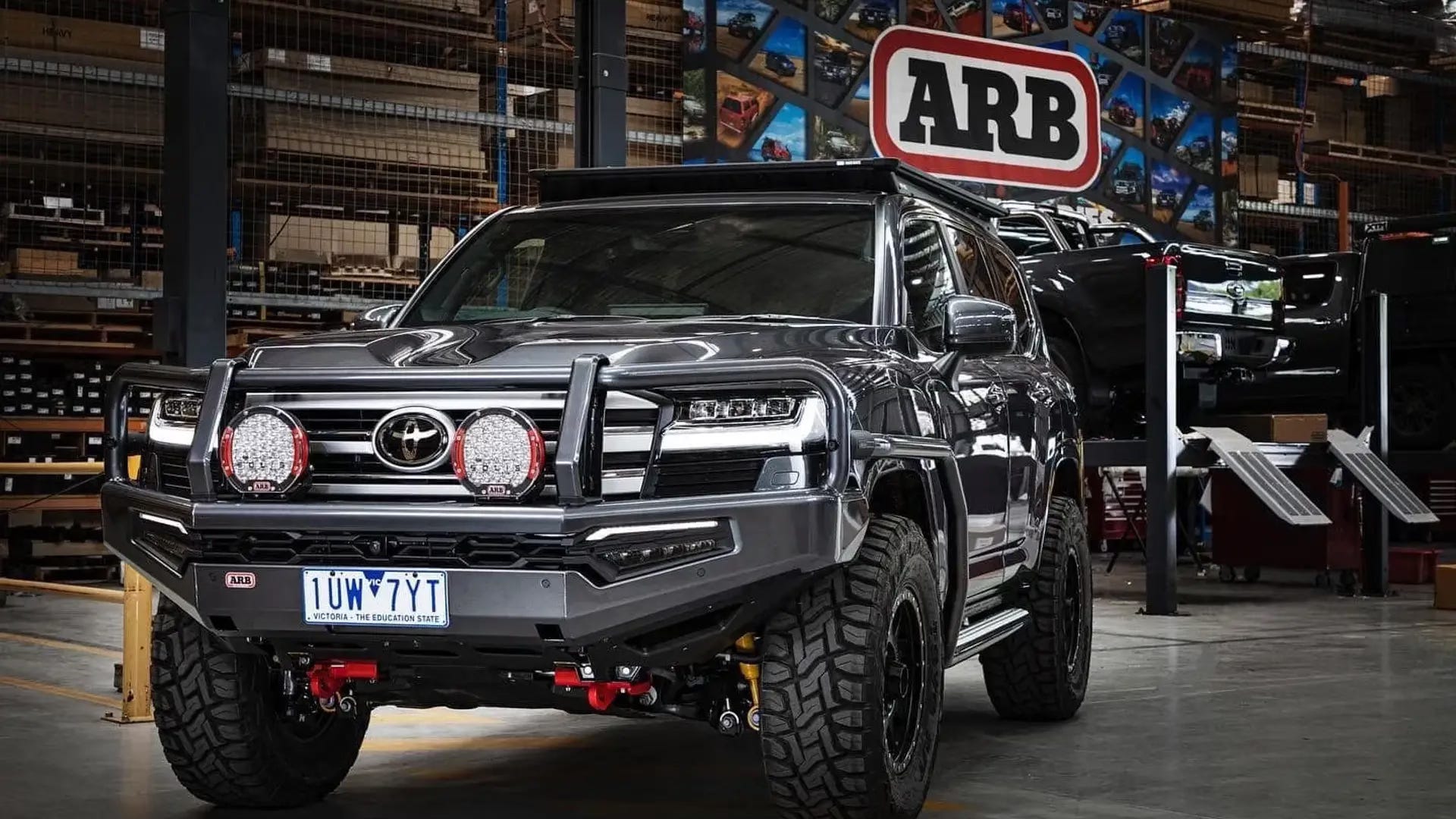
ARB Corporation designs, engineers, and manufactures bull bars, suspension systems, lighting, storage, and touring gear for 4WDs. It does this in Melbourne. It sells the products through 74 branded stores, exports to more than 100 countries, and now has Toyota and Ford designing factory vehicle trims around its products. The ARB logo stays on the bumper. That’s not white-labelling. That’s brand validation at the highest level.
The number that tells the story: 58.6% gross margins. In an industry where the major distributors operate at 25 to 30%. That gap isn’t pricing strategy. It’s a structural moat built over 50 years of engineering every accessory for every major 4WD platform on Australian roads.
Here’s the twist. ARB isn’t really in the same business as GPC and Bapcor. A mechanic calling Burson for brake pads is not choosing between Burson and ARB. ARB’s customer is doing a different job, personalising and enhancing their vehicle. The purchase is considered high-value (A$3,000 to $10,000+ for a fit-out) and mediated through a specialist fitment workshop, not a parts counter. The job is aspirational, not transactional.
How does an Australian manufacturer build global pricing power from a single product niche? And what does that tell us about what winning actually looks like?
If you’re on the board
The US bet is the strategy
ARB’s Australian business is mature and dominant. Growth depends on the ORW/4WP US retail build-out, potentially 50 to 53 stores, the largest 4x4 accessories network in the US. Near-term EBITDA compression of ~160 basis points is accepted. No material earnings until FY2027+. The 4WP acquisition (from Hoonigan’s bankruptcy) is still conditional on court approval. If the US play works, ARB has a global retail brand. If it doesn’t, the biggest strategic bet since Old Man Emu is a capital drain.
OEM partnerships made the aspirational job frictionless
ARB built its business on customers who want their 4WDs properly set up. Now, Toyota Trailhunter and Ford Licensed Accessories mean that customer (cashed up, not DIY, unbothered by luxury car tax or fuel economy) can drive a factory-modified 4WD off the showroom floor with a manufacturer’s warranty. OEM revenue grew 40.5% in FY2024. The question for the board: Does ARB’s identity shift from aftermarket brand to OEM design partner? And is that a feature or a risk?
The moat is a system, and A$125M only buys a seat at the table
Engineering intensity, Australian manufacturing, and controlled distribution form the structural barriers. Brand visibility and OEM endorsement compound them. TJM/Aeroklas has invested more than A$125 million since 2015 to rebuild from mid-tier. None has replicated the integrated system.
Every ARB bar on the road is a billboard
ARB competes in the same aftermarket ecosystem by industry classification. IBIS puts it at roughly 8.9% of Australian motor vehicle parts manufacturing and new parts wholesaling, the largest single player in those categories. But the strategic game is fundamentally different from the distribution contest that defines the rest of the industry.
GPC and Bapcor fight over who can get the brake pads to the workshop fastest. ARB fights over who designs, engineers, and manufactures the accessories that 4WD owners want enough to pay two to three times the price of an import.
The revenue tells the story. Australian aftermarket accounts for 58.3% of ARB’s A$693 million in FY2024 sales. Exports contribute 33.1%. OEM partnerships, the fastest-growing channel at 40.5% growth, add 8.6%. ARB operates 74 branded stores across Australia, 30 of them company-owned, controlling the fitment experience from the moment a customer walks in.
The buyer archetype is different too. ARB’s customer is an enthusiast 4WD owner or a fleet operator (mining companies, government agencies, trades) who buys through a specialist fitment workshop, not over a parts counter. A full ARB fit-out on a LandCruiser runs A$3,000 to $10,000 or more. The customer is choosing to personalise and enhance their vehicle. They’re not fixing something that broke.
And here’s where the brand economics diverge from everything else in the aftermarket: the physical product is the brand asset. GPC’s brand sits on a storefront. Bapcor’s brand sits on a delivery van. ARB’s brand sits on the front of every 4WD that leaves the workshop. Every bull bar on a LandCruiser touring the Gibb River Road is a permanent billboard. Mental availability isn’t built through advertising spend. It’s built through product visibility on every highway, mine site, and national park in the country.
The moat is a system, not a product
ARB’s competitive advantage is not one thing. It’s a system of reinforcing layers, and a competitor would need to replicate all of them simultaneously to pose a credible threat.
Engineering intensity. ARB employs more than 120 engineers designing accessories that are airbag-compatible, ADAS-integrated, ADR-compliant, and platform-specific. Each bar is engineered for each vehicle platform, a process that takes years of testing and compliance work. A cheap import cannot credibly replicate this for a modern vehicle, and rising vehicle complexity raises the floor on what competitors need to invest just to enter the market.
Australian manufacturing. ARB designs and manufactures in Kilsyth, Victoria, with a second facility in Thailand serving export and cost-base requirements. Vertical integration from design through manufacturing to retail means ARB controls quality at every step, protects intellectual property, and signals provenance to a customer base that values “designed and made in Australia.”
Controlled distribution. Seventy-four branded Australian stores, 30 company-owned, plus curated independent stockists and specialist 4WD outlets. ARB controls the retail and fitment experience. Margin stays in the system. The brand isn’t diluted by sitting on a shelf between competing products in someone else’s store.
These three layers, engineering, manufacturing, and distribution, are the structural barriers a competitor actually has to build. The brand visibility and OEM endorsement compound the effect, but a new entrant’s first problem is replicating the physical infrastructure, not the halo.
TJM, now owned by Thai conglomerate Aeroklas, has invested more than A$125 million since 2015 to rebuild as a premium innovator: airbag-certified bars, advanced suspension, global distribution ambitions. It’s the closest direct competitor. Ironman 4x4 targets the value-for-money segment. 4WD Supacentre serves entry-level buyers online. None has replicated the integrated system. A$125 million buys you a seat at the table. It doesn’t buy ARB’s 50 years of engineering data, OEM relationships, or brand recognition.
The quantitative proof: 58.6% gross margin in the first half of FY2025, the highest in at least 13 years, against a historical band of 53 to 58%. IBIS benchmarks ARB’s net margin at 13.4% versus a motor vehicle parts manufacturing industry average of negative 0.6%. Return on assets: 10.8% versus negative 0.47%. The moat isn’t theoretical. The margins are the evidence.
Toyota didn’t hire a supplier. They hired a brand.
The Toyota Trailhunter and Ford Licensed Accessories partnerships represent something genuinely new in the aftermarket: a premium accessories brand embedded in OEM vehicle design from the prototype stage, with its brand visible on the finished product.
When Toyota launched the Trailhunter grade for the Tacoma and 4Runner, it chose ARB citing 45-plus years of overlanding expertise, to supply factory-fitted Old Man Emu suspension, bumpers, roof racks, and recovery hardware as standard equipment. ARB engineers worked alongside Toyota’s design team from the concept stage. The result is a factory vehicle trim co-designed by an aftermarket brand.
Ford’s Licensed Accessories program operates differently but reinforces the same logic. ARB accessories for the Ranger and Everest are dealer-fitted, backed by Ford’s five-year unlimited-kilometre warranty, and can be financed as part of the vehicle purchase. For the buyer who wants their 4WD properly set up but doesn’t want to coordinate an aftermarket fit-out, cashed up, time-poor, happy to pay for convenience, this removes every friction point. The 4WD arrives modified off the showroom floor with a factory warranty. That’s a powerful proposition for a market segment that doesn’t flinch at luxury car tax or fuel economy.
OEM revenue reached A$59.6 million in FY2024, growing 40.5% year-on-year. Combined OEM and OEM-linked export revenue sits in the low teens as a percentage of group sales and is the fastest-growing channel. From FY2025, Trailhunter revenue flows through the export segment, blurring the distinction between OEM supply and international distribution.
The strategic signal matters more than the revenue line. OEMs could build overlanding accessories in-house. They could contract a Tier-1 supplier to white-label them. Instead, they outsourced to a 50-year-old company in Melbourne and kept its logo on the product. That tells you where the value sits — and where it doesn’t sit with anyone else.
The halo effect compounds. A Trailhunter owner in Texas who discovers the ARB logo on their factory bumper becomes an ARB aftermarket customer. They buy the fridge. The awning. The storage system. OEM channels create brand awareness; retail channels convert it. The two reinforce each other.
The question for the board isn’t whether OEM partnerships are good. They clearly are. The question is what happens to ARB’s identity as this channel scales. Does ARB remain an aftermarket brand that happens to supply OEMs? Or does it gradually become an OEM design partner that happens to run aftermarket stores? The distinction matters for capital allocation, brand positioning, and how the market values the company.
From Kilsyth to Kansas
ARB’s Australian business is mature. Australasia revenue was A$667 million in FY2025, essentially flat at negative 0.8% growth. The domestic retail channel has 74 stores and covers every major population centre. The fleet and wholesale relationships are deep. The brand is dominant. The obvious question: where does the next phase of growth come from?
The answer is the United States and it’s the riskiest strategic bet ARB has made since Roger Brown developed Old Man Emu suspension in the 1980s.
ARB holds a 30% stake in Off Road Warehouse (ORW), which operates 11 stores in the US. A conditional acquisition of 4 Wheel Parts, 42 stores, purchased from Hoonigan’s bankruptcy for approximately US$30 million, would see ARB’s stake in ORW rise to 50%. If completed, the combined network of roughly 50 to 53 stores would be the largest 4x4 accessories retail operation in the United States.
US segment revenue reached A$88.5 million in FY2025, growing 20.3%. ARB has also launched a direct-to-consumer e-commerce site, acquired the Poison Spyder brand for US$1 million, and invested in Nacho LED. The pieces of a US retail platform are being assembled.
The theory is elegant. Toyota Trailhunter creates brand awareness in the US market. The ORW/4WP retail network converts that awareness into transactions. Owned stores build the branded fitment experience. Over time, the model replicates elements of what ARB built in Australia, controlled distribution, specialist fitment, and brand-immersive retail.
The execution risk is real.
4 Wheel Parts came out of bankruptcy. The operational quality of 42 stores acquired from a failed parent is unknown. Integration across a fragmented US retail operation is complex. ARB’s brand recognition in the US is growing but nowhere near Australian levels. Near-term EBITDA compression of roughly 160 basis points is accepted. No material earnings contribution is expected until FY2027 at the earliest.
Everything ARB does well, engineering, product design, OEM partnerships, travels across borders. The product is the same in Kansas as it is in Kilsyth. What doesn’t travel easily is the other half of the model: local retail execution, fitment culture, and customer trust built through decades of face-to-face relationships. ARB’s entire Australian system was built organically over 50 years. The US play is the first attempt to acquire and build that system in a foreign market at speed.
The bet is strategically sound. The US is the world’s largest market for 4WD and off-road accessories, and ARB enters with a product moat that most US competitors, general off-road retailers, and online discounters simply don’t have. The OEM halo from Trailhunter provides a brand accelerant no other entrant can match.
But the question the board must answer is binary: if the US play works, ARB has a global retail brand with distribution infrastructure across the world’s two largest 4WD markets. If it doesn’t, the company has absorbed near-term margin compression and management distraction for a footprint that generates no return.
What to Watch
Metrics
US segment EBITDA margin: The proof that owned retail in the US generates profit, not just revenue growth. Get it from ARB half-yearly results, push for separate US margin disclosure.
4WP acquisition completion: Conditional on court approval. If it doesn’t complete, the US footprint is 11 stores, not 50+. Get it from ARB ASX announcements.
OEM revenue as % of group: Tracks whether the OEM channel is diversifying revenue or becoming a concentration risk. Get it from ARB annual and half-yearly results.
AU aftermarket like-for-like growth: Has the domestic channel reached its ceiling? If flat, the US thesis becomes essential, not optional. Get it from ARB segment commentary.
Gross margin trend: 58.6% is the headline. If it holds above 55% while US and OEM scale, the moat is intact. Get it from ARB half-yearly results.
Key dates
August 2026. ARB FY2026 full-year results. First full year with Trailhunter revenue flowing through exports. US segment scale becomes clearer.
FY2025/26. 4WP acquisition completion (conditional on court approval). The US footprint either scales to 50+ stores or stalls at 11.
FY2027+. The earliest window for material US earnings contribution. If store-level profitability isn’t emerging by then, the thesis needs revisiting.
Ongoing. New OEM partnership announcements. Each additional vehicle platform compounds the moat and extends brand reach into new buyer segments.
The question that lingers
GPC and Bapcor are playing hard in a mature, low-growth distribution market and both have strategies that could work. ARB found a different game entirely: a premium product and brand moat in a newer consumer wave with structural tailwinds. The question is whether a 50-year-old company from Kilsyth can build in Kansas what it built in Melbourne, not just stores, but the engineering culture, fitment expertise, and brand trust that make those stores worth walking into.
Based on publicly available information including ARB Corporation annual reports, half-yearly results, ASX announcements, IBIS industry reports, and analyst coverage.
The series
The A$21 billion fight for your mechanic's first call

Every morning, thousands of workshop mechanics across Australia make the same decision: who do I call first for parts?
GPC has the biggest chequebook in auto parts but it might not matter

GPC Asia Pacific, the company behind Repco, NAPA, Sparesbox, and a growing collection of specialist brands, is having a very good run. Double-digit local currency growth. Market share gains. Multiple acquisitions in eighteen months. All while its nearest competitor, Bapcor, burns through CEOs and financial surprises.
Bapcor's real problem: 42 ERPs and no theory of winning

Five leadership transitions in two years, including an appointment that was withdrawn before it started. Share price down more than 75% from its 2021 peak. Nearly $78 million in accounting surprises discovered in businesses the company already owned, plus a further $15 million in operational shortfalls flagged in December 2025.
ARB has 58% gross margins in a 25% industry

Somewhere in this series, you might have noticed a pattern. GPC has global scale and a $24 billion parent. Bapcor has the broadest portfolio in the market. Both are fighting for the same thing: the mechanic’s first call. Both have real strategies for winning it.